
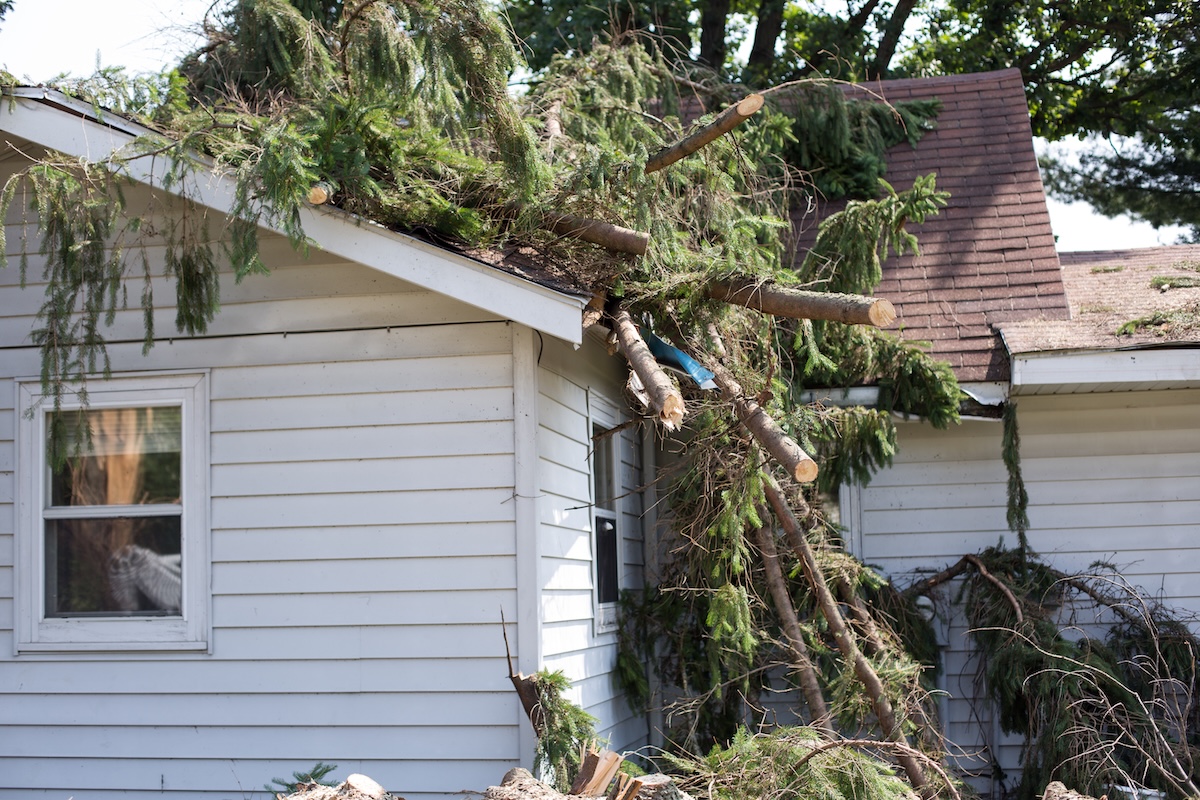
Tree Damage to a Minneapolis Roof: Insurance Coverage and the Cleanup Process
Think of a tree falling on your house like a car accident where no one was at fault. There’s damage, there’s a claim, there’s an adjuster, and there’s a timeline — but unlike a fender bender, the “other driver” in this metaphor is the weather, and insurance companies have spent a hundred years refining how they handle that specific kind of collision.
This guide walks Minneapolis homeowners through the full process of a tree damage roof insurance claim: what’s covered, what isn’t, the neighbor-tree question that trips everyone up, the 7-step response from storm hour 1 through reconstruction, and the claim realities most homeowners don’t learn until they’re living them.
When a tree falls on your Minneapolis roof: what insurance covers
The Minnesota homeowner policy treats tree damage as a straightforward covered loss in most cases. Here’s how it breaks down:
| Scenario | Covered by | Typical outcome |
|---|---|---|
| Your tree falls on your house | Your homeowner policy | Roof, structure, interior covered. Tree removal typically covered up to $500–$1,000 sub-limit. |
| Neighbor’s tree falls on your house (no negligence) | Your homeowner policy | Same as above — your policy pays, then potentially subrogates |
| Neighbor’s tree falls on your house (documented neglect, e.g. dead tree they were warned about) | Neighbor’s liability | Your policy pays first, then subrogates against neighbor’s insurance |
| Tree falls in yard, no house damage | Usually not covered | Insurance rarely covers tree removal alone without structural damage |
| Tree damages fence only | Partial coverage | Fence covered under other structures, usually with sub-limit |
| Tree damages car in driveway | Auto comprehensive coverage | Your auto policy (not homeowner) pays |
The single biggest source of confusion: homeowners assume the tree’s owner’s insurance pays. It usually doesn’t, at least not initially. Your policy pays first because your policy covers your property. If there’s documented negligence, your insurer may go after the neighbor’s carrier later — but that’s a carrier-to-carrier matter, not your job to pursue.
The 7-step response: tree damage roof insurance claim from hour 1
Like a car accident, what you do in the first 24 hours determines the size of the problem:
- Safety first. Turn off electricity to affected rooms if water is reaching fixtures. Evacuate if structural damage is visible. Don’t approach downed power lines.
- Document everything before cleanup. Photos from every angle of the tree, the damaged roof, the interior. Timestamped. The more photos, the smoother the claim.
- Emergency tarp. Cover the punctured area with a professional tarp if water is entering. Save the invoice. See our emergency roof tarp storm response Minneapolis guide.
- Open the claim. Call your carrier’s claim line within 24–48 hours. Describe what happened factually. Get a claim number.
- Hire a licensed tree removal service. Only after you have a claim number and the adjuster has been notified. Tree removal pros coordinate with insurance and crane operators for large tree work.
- Get an independent roof inspection. After the tree is cleared, a licensed Minneapolis roofer documents structural damage, decking damage, shingle damage, and any interior impacts. See the Minneapolis roofing companies pillar.
- Meet the adjuster with documentation in hand. Your roofer’s written scope of loss is the anchor document. The adjuster may need a structural engineer’s opinion if decking or trusses were hit. See our working with your insurance adjuster guide.
Moving in that order keeps the claim clean. Out-of-order moves — cleaning up before documenting, signing with a contractor before opening the claim — tend to produce problems that show up weeks later when the scope is being negotiated.
The neighbor-tree question: who pays when it’s someone else’s tree?
This is the question that generates the most confusion and the most bad advice on Nextdoor, so let’s be precise:
- Default rule: your policy pays. Your insurer covers damage to your property regardless of whose tree fell. This applies whether the tree was yours, your neighbor’s, or unclaimed (a tree on a boundary, a tree from a vacant lot, a tree on municipal property).
- Exception: documented negligence. If you had previously notified your neighbor in writing that their tree was dead, diseased, or a hazard, and they took no action, there may be grounds for their liability policy to pay. This is rare, and it requires documentation of the warning.
- Subrogation happens carrier-to-carrier. Your insurer investigates and, if there’s a valid subrogation claim, goes after the neighbor’s carrier. This process is invisible to you and doesn’t speed up or slow down your claim.
- Deductible recovery. If subrogation succeeds, you may get your deductible back months or years later. Don’t count on it.
For the broader framework, see the Minneapolis storm damage roof insurance claim pillar. For money-math context, the Minneapolis roof replacement cost pillar.
People want the neighbor’s tree to be the neighbor’s problem. It usually isn’t, and that’s not your insurance company being cheap — it’s the design of the homeowner policy. Your policy covers your property. The neighbor-liability exception is real but narrow, and chasing it won’t speed up your repair. File your own claim. Let the carriers sort out who owes whom in the background.
— Paraphrased from a 2024 Insurance Information Institute consumer brief on tree-fall liability
What Minneapolis tree damage roof claims actually pay
Rough dollar ranges for common tree-damage scenarios on a typical Minneapolis 2,500 sq ft home:
| Damage scenario | Typical claim range (2026) |
|---|---|
| Large branch on one slope, no structural damage | $8,000 – $18,000 |
| Full tree on house, localized roof + decking damage | $18,000 – $40,000 |
| Full tree, structural damage to trusses or walls | $40,000 – $120,000+ |
| Tree on detached garage | $10,000 – $35,000 |
| Tree on fence only | $1,500 – $6,000 |
| Emergency tree removal (covered sub-limit) | $500 – $1,000 typically |
| Interior water / structural repair from tree penetration | $5,000 – $30,000 |
The deductible is yours either way. Removal cost above the policy sub-limit is usually on you unless the tree damaged a covered structure (in which case removal becomes part of the damage claim). Total out-of-pocket on a clean RCV policy with a $2,500 deductible is usually just the deductible itself — the rest flows through the claim process.
For the claim call, see how to file a roof insurance claim. For contractor selection, the Minneapolis roofing companies pillar. For tarp service detail, emergency roof tarp storm response Minneapolis. Further reading: the Insurance Information Institute tree-damage brief, the MN Department of Commerce home insurance page, and the NAIC homeowners claim guide.
Frequently Asked Questions
Does my Minneapolis homeowner insurance cover a tree falling on my roof?
Yes, almost always. Under standard HO-3 policies, tree damage is a covered peril regardless of whose tree fell. Your carrier pays for roof repair / replacement, structural damage, and interior damage, minus your deductible. Tree removal is covered up to a policy sub-limit, typically $500–$1,000 when a covered structure is damaged.
If my neighbor’s tree falls on my house, does their insurance pay?
Usually not. Your policy pays first because your policy covers your property. Your insurer may subrogate against your neighbor’s carrier if there’s documented negligence (e.g. you warned them about a dead tree), but that’s a carrier-to-carrier process invisible to you. Don’t delay filing your own claim hoping the neighbor’s policy will pay.
Is tree removal covered under Minneapolis homeowner insurance?
Partially. Most policies cover tree removal up to a sub-limit ($500–$1,000) when the tree damaged a covered structure like your house, garage, or fence. Tree removal from the yard alone — with no structural damage — is usually not covered. Removal cost above the sub-limit is typically on the homeowner.
How quickly should I file a tree damage claim on my Minneapolis roof?
Within 24–48 hours of the event. Get a claim number before hiring tree removal or any contractor. The sequence matters: document, tarp, open the claim, then clean up. Order-of-operations problems create documentation gaps the adjuster later has to interpret.
What’s the biggest mistake Minneapolis homeowners make with tree damage claims?
Cleaning up the tree before documenting and filing. Once the tree is off the house, the adjuster is working from photos and memory. Preserve the scene, open the claim, then remove the tree. Also avoid signing with any contractor who shows up pitching ‘we’ll handle everything’ before the claim is even open — that’s usually an AOB setup.
Looking for a Minneapolis roofer for tree-damage rebuilds?
We’re Minneapolis Roofing Company — a licensed, insured, local crew that documents every shingle, works straight with adjusters, and never pushes an AOB or a deductible-waiver scheme. If you’re looking for a Minneapolis roofer for tree-damage rebuilds, we’d love to be the name you recommend to your neighbor after the storm.
