
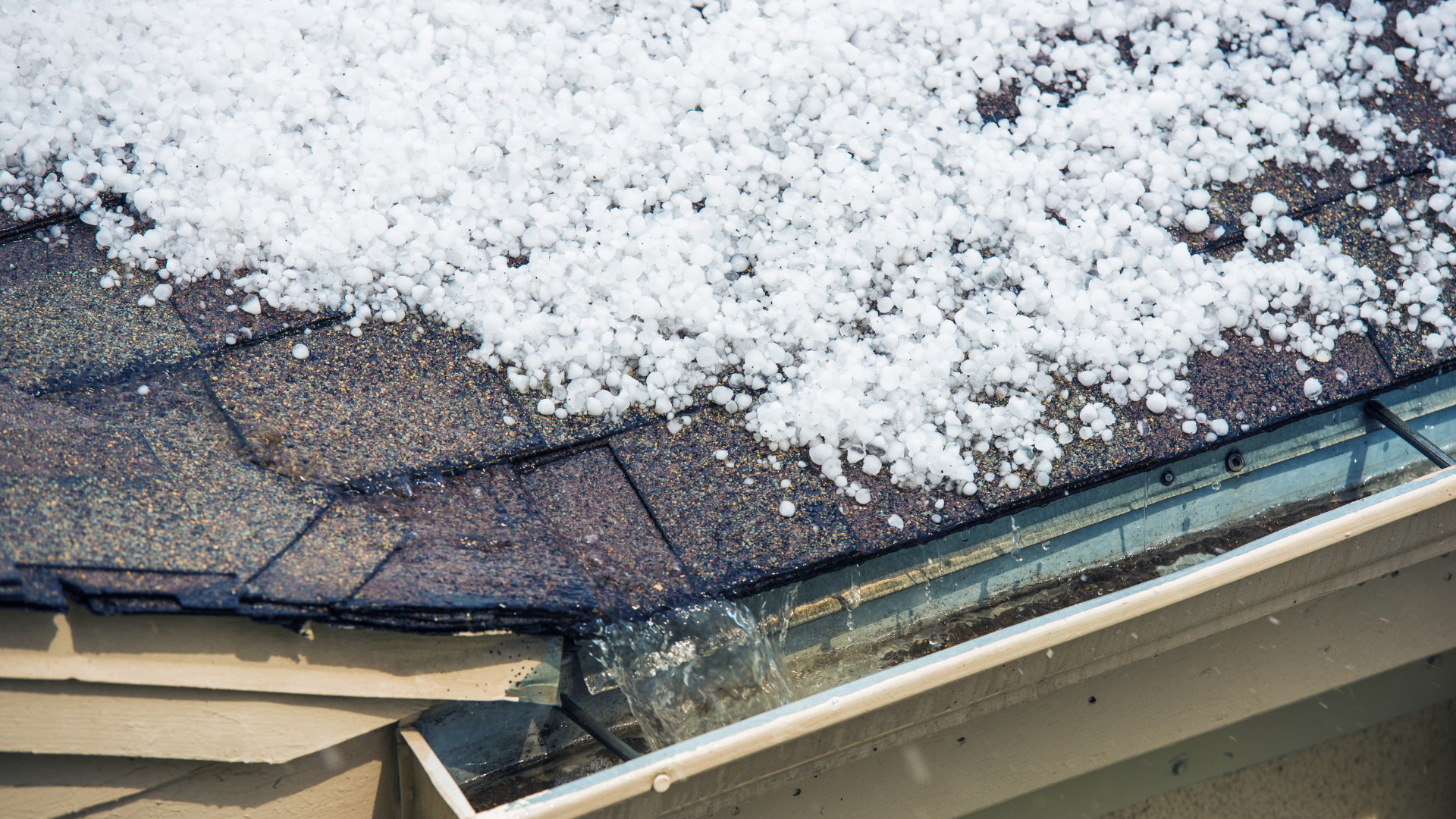
What Size Hail Damages a Roof? A Minneapolis Homeowner’s Guide to the 2026 Hail Season
You’re standing at the kitchen window watching hail hit the deck. Quarters? Golf balls? The weather radio just said “ping pong ball-sized.” Your first question — the one every Minneapolis homeowner asks in that exact moment — is whether this storm actually did something to your roof, or whether it’s about to pass through with nothing more than a loud soundtrack.
Here’s the honest answer: hail damage on a residential asphalt roof starts around 1” diameter in most Minneapolis conditions, and becomes progressively worse from there. This guide walks through the real damage thresholds by material, how to check what hit your specific neighborhood, and when hail triggers a legitimate insurance claim vs. cosmetic-only damage.
What size hail damages a roof: thresholds by material
| Hail size | Visual comparison | Asphalt shingle | Metal / premium | Flat / TPO |
|---|---|---|---|---|
| Under 1” (pea – marble) | Small marble | Rarely causes damage | No damage | No damage |
| 1” (quarter) | Quarter | Possible granule loss | Cosmetic only | No damage |
| 1.25” (half-dollar) | Half-dollar | Bruising + granule loss | Light dents possible | Possible puncture |
| 1.5” (ping pong ball) | Ping pong ball | Claimable damage (widespread) | Cosmetic dents | Puncture risk |
| 1.75”—2” (golf ball) | Golf ball | Severe damage + replacement | Structural dents | Likely puncture |
| 2”+ (tennis ball & up) | Tennis ball+ | Total replacement scenario | Structural damage | Total replacement |
A few things to notice. First, the thresholds depend heavily on material. Standing-seam metal can take ping-pong-ball hail with nothing but cosmetic dents. Asphalt at the same size is often a claim. Second, the damage “starts” around 1” but becomes widely claimable at 1.25”–1.5” — and that’s also the threshold most Minneapolis carriers use for a clear approval. Third, wind during the storm matters: 1” hail at 50 mph hits harder than 1” hail in still air.
How to check what size hail actually hit your Minneapolis neighborhood
You can’t rely on what it looked like from the kitchen window. Here’s how to actually verify:
- Check NOAA / NWS hail reports. The National Weather Service publishes per-storm hail estimates on their public warning data. Search your ZIP code plus the storm date.
- Look at HailTrace, CoreLogic, or similar third-party hail data. Many Minneapolis insurance adjusters cross-reference these for claim decisions.
- Walk your yard the morning after. Look for hail dings on gutters, soft metal items (grills, car hoods, AC condensers), siding, and fence tops. Dings on these surfaces correlate with roof damage.
- Check cars that were parked outside. A car with no hail damage strongly suggests the roof isn’t claimable either.
- Get an independent roof inspection. A licensed Minneapolis contractor can chalk-mark damage and provide a photo report. See our how to spot hail damage walk-through.
Third-party hail data is what adjusters use to decide marginal claims. If HailTrace says your block got 1.5” stones, and your roof shows corresponding bruising, you have a claim. If the data says your block got 0.75” stones, and your roof shows scattered granule loss, you probably don’t.
Why “functional damage” matters more than size alone
Size is the starting point. What actually triggers an insurance claim is functional damage — damage that shortens the roof’s service life. Carriers care about three markers:
- Granule loss. Hail exposes the asphalt mat and the fiberglass scrim underneath by knocking off the protective granules. Exposed mat ages 2–4x faster under UV.
- Bruising or soft spots. A hail strike can fracture the mat without removing granules. Over 6–18 months, these bruises open into cracks or leaks.
- Puncture or tear. Through-damage on any material. Always a claim.
This is why hail damage isn’t always obvious from the ground. A roof that looks normal can have hundreds of bruise strikes that will open as cracks over the next winter. That’s why chalk-marked inspections (where a roofer circles each strike) are the standard documentation for a claim.
The golf-ball-sized hail that cracks a hood is the same hail that bruises a shingle. You won’t always see the bruise from the ground, but it’s there, and it’ll leak in 18 months. Document damage the morning after. Don’t assume a ‘lucky’ roof because it looks fine from below.
— Paraphrased from a 2024 Insurance Information Institute consumer briefing
When hail damage triggers a legitimate Minneapolis insurance claim
A quick decision framework:
- Claim clearly worth filing: 1.25”+ hail confirmed on public data, visible damage on gutters and car hoods, and a contractor inspection that finds 8+ strikes per 10’×10’ test square.
- Claim probably worth filing: 1” hail confirmed, some visible damage, and an inspection finds 4–7 strikes per test square.
- Claim probably not worth filing: under 1” hail, no car or gutter damage, inspection finds scattered granule loss consistent with aging rather than hail.
- Don’t file: no confirmed hail event on public data, no visible damage, or your roof is simply old and failing (not hail damage).
For the broader claim process, see our Minneapolis storm damage roof insurance claim pillar and how to file a roof insurance claim guide. For claim-money math, the Minneapolis roof replacement cost pillar. Further reading: the NOAA severe-weather center, the Insurance Information Institute hail brief, and the NRCA consumer center.
Frequently Asked Questions
What size hail actually damages a Minneapolis asphalt roof?
Clear damage usually starts at 1” diameter (quarter-sized) and becomes widely claimable at 1.25”–1.5” (half-dollar to ping pong ball). Under 1” is usually cosmetic-only on asphalt; 2”+ almost always triggers full replacement.
How do I know what size hail hit my specific Minneapolis neighborhood?
Check NOAA / NWS storm reports, HailTrace, or CoreLogic third-party data by ZIP and date. Cross-reference with visible damage on gutters, car hoods, grills, and AC units. If those surfaces show dings, your roof likely does too.
Can 3/4” hail damage my roof?
Rarely causes claimable damage to asphalt shingles on its own. Sub-1” hail can exacerbate existing granule loss on an older roof but usually isn’t enough for a clean claim approval. Check with an independent roofer before filing a marginal claim.
Do I have a hail claim if my car is damaged but my roof looks fine from the ground?
Quite possibly. Most hail roof damage isn’t visible from the ground — bruising and mat fractures hide under the granules. If your car, grill, or gutters have dings, get a chalk-marked roof inspection before assuming your roof is fine.
How much hail damage is ‘enough’ for insurance to approve a claim?
Most Minneapolis carriers approve when there are 8+ documented strikes per 10’×10’ test square and the hail event is verified at 1”+ on third-party data. Marginal cases with fewer strikes may approve slope-only repair or deny entirely.
Looking for a Minneapolis hail roof inspection you can trust?
We’re Minneapolis Roofing Company — a licensed, insured, local crew that documents every shingle, works straight with adjusters, and never pushes an AOB or a deductible-waiver scheme. If you’re looking for a Minneapolis hail roof inspection you can trust, we’d love to be the name you recommend to your neighbor after the storm.
