
Attic Ventilation and Your Minneapolis Roof: Why It Matters More in Minnesota Than Most Markets
Attic ventilation is the quiet secret of every long-lasting Minneapolis roof. Most homeowners never think about it, most realtors never discuss it at sale, and most home inspectors glance at it and move on. But inadequate attic ventilation is the single biggest hidden cause of early Minneapolis roof failure: premature shingle aging, chronic ice dams, moisture damage to decking, and failed manufacturer warranty claims.
This is the briefing every Minneapolis homeowner should read before any roof replacement: why attic ventilation matters, how the soffit-to-ridge airflow system actually works, how Minnesota climate makes this more important than in other markets, and how to confirm your roof install includes proper ventilation updates.
Attic ventilation and the Minneapolis roof: what airflow actually does
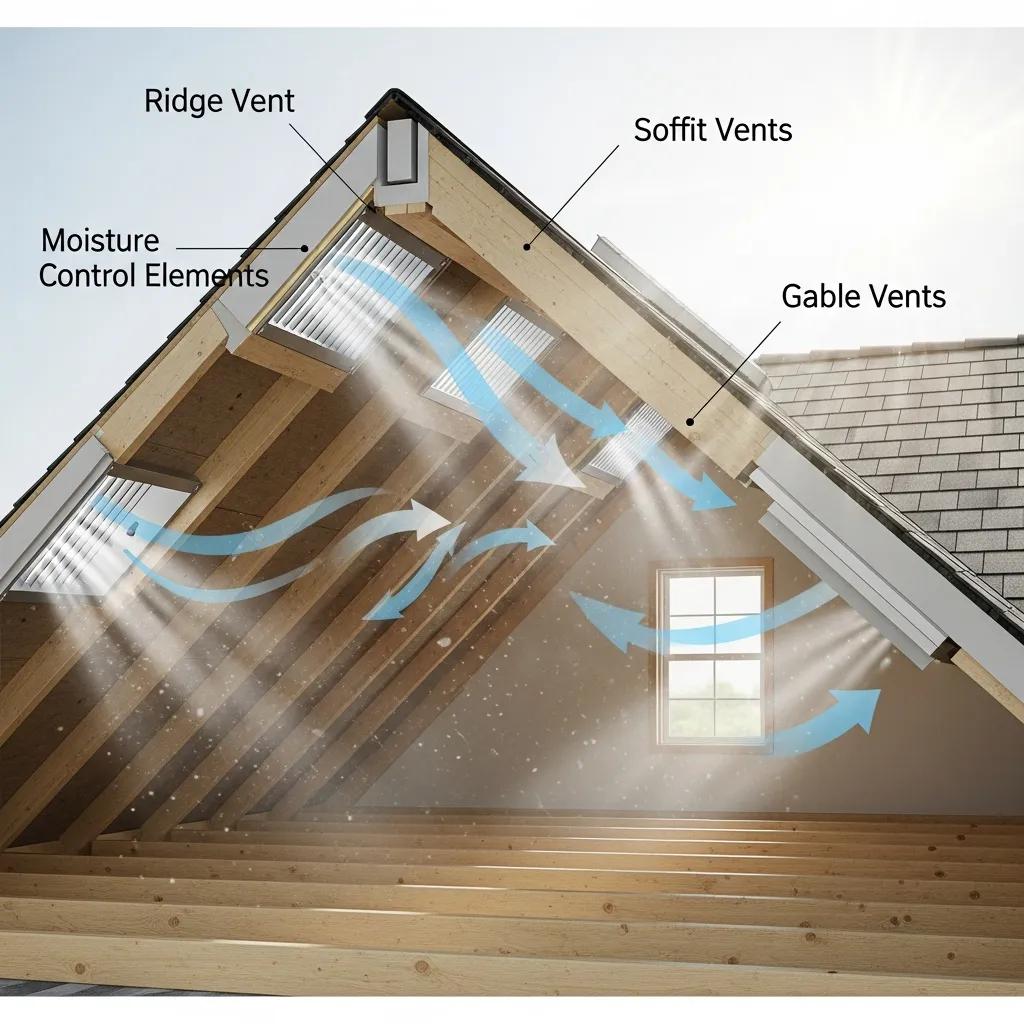
A properly ventilated attic maintains continuous cool airflow from soffit vents (low) up through the attic to ridge vents (high). Cool air enters at the eaves, warms as it rises through the attic, and exits at the ridge. This airflow accomplishes four things critical in Minneapolis climate:
- Prevents ice dams in winter. Without ventilation, attic heat (from interior leakage, recessed lights, HVAC losses) warms the roof deck, melts snow from underneath, and forms ice dams at the cold eaves. Ventilation keeps the attic cold and the roof deck temperature uniform, which is the single most effective ice dam prevention.
- Removes moisture year-round. Cooking, showering, laundry, and human respiration generate water vapor inside the home. Some of that vapor migrates into the attic. Without ventilation, it condenses on cold surfaces and causes decking rot, mold, and insulation degradation.
- Reduces summer shingle aging. In July and August, attic temperatures in poorly-ventilated Minneapolis homes can reach 140°F+. That heat accelerates asphalt shingle aging significantly. A well-ventilated attic runs 25–40°F cooler, extending shingle life by years.
- Preserves manufacturer warranty eligibility. GAF, CertainTeed, Owens Corning, and other major shingle manufacturers require proper attic ventilation for warranty eligibility. An inadequately-ventilated attic can void shingle warranties even when the shingles themselves are installed perfectly. See best asphalt shingle brands in Minneapolis for brand-specific warranty notes.
The rule-of-thumb industry standard is 1 square foot of net free ventilation area (NFVA) for every 150 square feet of attic floor space, with 50/50 split between intake (soffit) and exhaust (ridge / box vents). For a typical Minneapolis 2,500 sq ft home with conditioned space, that’s roughly 17 sq ft of total NFVA — a number most 1980s and earlier homes don’t meet.
Attic ventilation systems in Minneapolis: soffit, ridge, gable, and power vents
Four ventilation system types are common on Minneapolis roofs in 2026. Understanding how they interact is essential to specifying a proper system:
| Vent type | Role | Typical NFVA per unit | Best use case |
|---|---|---|---|
| Continuous soffit vent | Low intake — brings cool air in | 9 sq in / linear ft typical | Essential on all homes; primary intake |
| Continuous ridge vent | High exhaust — releases warm air | 18 sq in / linear ft typical | Essential on most homes; primary exhaust |
| Box vent (static) | High exhaust — point exhaust | 50–75 sq in per vent | Supplemental on complex roofs without long ridge |
| Gable vent | Cross-flow or exhaust | Variable by size | Legacy; often problematic with ridge vent systems |
| Power (attic fan) | Forced exhaust | Variable | Rarely needed; can pull air from interior if soffit is blocked |
The modern Minneapolis standard: continuous soffit-to-ridge ventilation with supplemental box vents only where roof geometry prevents continuous ridge coverage. Gable vents generally should NOT be combined with ridge vents — the two create competing airflow patterns that short-circuit the soffit-to-ridge system. Either use one or the other, not both.
Power attic fans are rarely the right answer in Minneapolis. When soffit intake is blocked (common on older homes with insulation stuffed against the roof deck), a power fan pulls air from the path of least resistance — often the conditioned living space below — wasting heating/cooling energy and creating negative pressure issues. Fix the intake first, and passive ventilation usually solves the problem. For decking implications, see roof decking: OSB vs plywood in Minneapolis.
Signs your Minneapolis attic ventilation is failing (and what to do)
Five common signs of inadequate attic ventilation in Minneapolis homes. If any match your home, address ventilation as part of your roof replacement project rather than separately:
- Chronic ice dams every winter. Ice dams aren’t always a sign of ventilation failure — sometimes insulation is the culprit — but ventilation is involved in most chronic cases. If you’ve fought ice dams every year for 5+ years, the next roof is the moment to address ventilation. For ice dam prevention detail, see ice and water shield in Minneapolis.
- Frost on attic rafters and decking in winter. Pull down the attic access on a February morning after a cold night. If you see frost crystals on rafters, roof decking, or insulation surfaces, attic moisture is condensing. Ventilation is inadequate.
- Asphalt shingles showing premature granule loss. Look at your current shingles. If they’re losing granules heavily on south-facing slopes at year 12–15 of a 25–30 year shingle, the attic heat is cooking them from below. Better ventilation on the next install will extend shingle life significantly.
- Soffit vents blocked or absent. Climb into the attic (carefully) on a bright day. Look toward the eaves. If you see daylight at the soffit area, intake is working. If it’s dark and you can see insulation stuffed against the decking, intake is blocked. Ventilation isn’t functioning regardless of what exhaust system is installed.
- Second-floor rooms running hot in summer and cold in winter. Poor attic performance translates directly to upstairs comfort. Inadequate ventilation drives extreme attic temperatures that radiate through ceilings into second-floor rooms.
Any of these signs should trigger a ventilation review during your next roof replacement. A quality Minneapolis contractor will inspect the existing ventilation, calculate NFVA against the 1:150 standard, and recommend upgrades to bring the system into compliance.
The attic ventilation fix at roof replacement time is the single highest-ROI upgrade most Minneapolis homeowners can make. Adding continuous soffit vents on a home that’s missing them costs $800–$1,800. Adding continuous ridge vent costs $400–$900. The combined investment of roughly $1,500 typically extends shingle life 5–8 years on the next roof, reduces summer cooling bills 15–30% on the upper floor, and eliminates most ice dam risk. The payback is usually under 5 years.
— Paraphrased from a 2024 Department of Energy residential attic performance briefing
Attic ventilation on your Minneapolis roof replacement: what to specify
Six line items every Minneapolis homeowner should verify in their roof replacement contract regarding ventilation:
- Ventilation inspection included. Contractor should inspect existing soffit intake and attic exhaust before quoting. The quote should document current NFVA and identify gaps.
- NFVA calculation shown. Quality contractors will calculate required intake and exhaust NFVA based on your attic floor area and the 1:150 (or 1:300 with vapor barrier) standard and match proposed ventilation to the requirement.
- Continuous ridge vent specified when appropriate. Where ridge length allows, continuous ridge vent is the modern standard. Contract should name the specific product (GAF Cobra, CertainTeed FilterVent, Owens Corning VentSure).
- Soffit vent work included if needed. If existing soffits are blocked by insulation or the home was built without continuous soffit vents, the contract should specify the scope of soffit work needed — this is separate from roof tear-off and re-install.
- Gable vent handling specified. If the home has gable vents that will interact poorly with new ridge vent, the contract should address them: close off, retain as primary, or reconfigure.
- Insulation baffles included at eaves. Plastic baffles (also called insulation dams or ventilation chutes) keep soffit intake open when insulation is installed to proper depth. Essential on any project that includes insulation work.
For contractor selection process, see the Minneapolis roofing companies pillar. For cost implications, the Minneapolis roof replacement cost pillar. For the storm damage claim angle, the Minneapolis storm damage claim pillar. For the materials overview this ventilation system supports, the Minneapolis roofing materials pillar. For the flashing and ridge cap integration with ridge vent, roof flashing, drip edge, and ridge caps. Further reading: the Department of Energy insulation and ventilation resource, the NRCA consumer center, and the International Code Council IRC reference.
Frequently Asked Questions
How much attic ventilation does a Minneapolis home need?
The industry standard is 1 square foot of net free ventilation area (NFVA) for every 150 square feet of attic floor, split roughly 50/50 between intake (soffit) and exhaust (ridge / box). With a properly installed vapor barrier, this can be reduced to 1:300. For a typical 2,500 sq ft Minneapolis home, that’s roughly 17 sq ft total NFVA.
Why does attic ventilation matter so much in Minneapolis?
Minnesota climate compounds ventilation failures. Inadequate ventilation in winter drives ice dam formation; in summer it cooks shingles at 140°F+ attic temperatures; year-round it allows moisture buildup that damages decking and insulation. Proper ventilation prevents all three failure modes and preserves manufacturer shingle warranty coverage.
Should I use a power attic fan on my Minneapolis home?
Rarely. Power fans often pull conditioned air from interior living space when passive soffit intake is blocked, wasting HVAC energy. The better fix is correcting soffit intake and installing continuous ridge vent for passive soffit-to-ridge airflow. Power fans are a last-resort option when architectural constraints prevent proper passive ventilation.
Can my old Minneapolis home’s attic ventilation be upgraded during a roof replacement?
Yes, and it should be. Roof replacement is the ideal time to add continuous ridge vent, correct blocked soffit intake, close off problematic gable vents, and install insulation baffles. Budget roughly $1,000–$2,500 in ventilation upgrades on older Minneapolis homes — the payback is usually under 5 years through extended shingle life and lower cooling costs.
Does attic ventilation affect shingle warranty in Minneapolis?
Yes. Major shingle manufacturers (GAF, CertainTeed, Owens Corning, IKO, Malarkey) explicitly require proper attic ventilation for warranty eligibility. An inadequately ventilated attic can void your shingle warranty even when shingles are installed perfectly. Verify your ventilation meets manufacturer specifications as part of the install.
Looking for a Minneapolis roofer who addresses attic ventilation during roof replacement?
We’re Minneapolis Roofing Company — a licensed, insured, local crew that installs asphalt, metal, and synthetic systems across the Minneapolis metro. If you’re looking for a Minneapolis roofer who addresses attic ventilation during roof replacement, we’d love to be the name you recommend to your neighbor after the install.
