
Ice and Water Shield in Minneapolis: Coverage Zones, Code, and Why It Pays for Itself
If you’ve ever seen an ice dam form along the eave of a Minneapolis roof, you understand the problem ice-and-water shield exists to solve. Ice dams form when attic heat melts snow on the upper roof, meltwater flows down the slope, and refreezes when it hits the cold overhang. The ice ridge then backs up liquid water underneath the shingles — and that backed-up water is what destroys drywall, insulation, and flooring in Minneapolis homes every January.
Standard shingles and felt underlayment can’t stop ice-dam back-up. Only one product can: self-adhering rubberized asphalt membrane, commonly called ice and water shield. This is the homeowner’s guide to ice and water shield in Minneapolis: what Minnesota code requires, where coverage is smart to extend, how the product actually works, and why full-coverage installs are increasingly common on hail-and-snow-belt homes in 2026.
Ice and water shield in Minneapolis: what it is and how it works
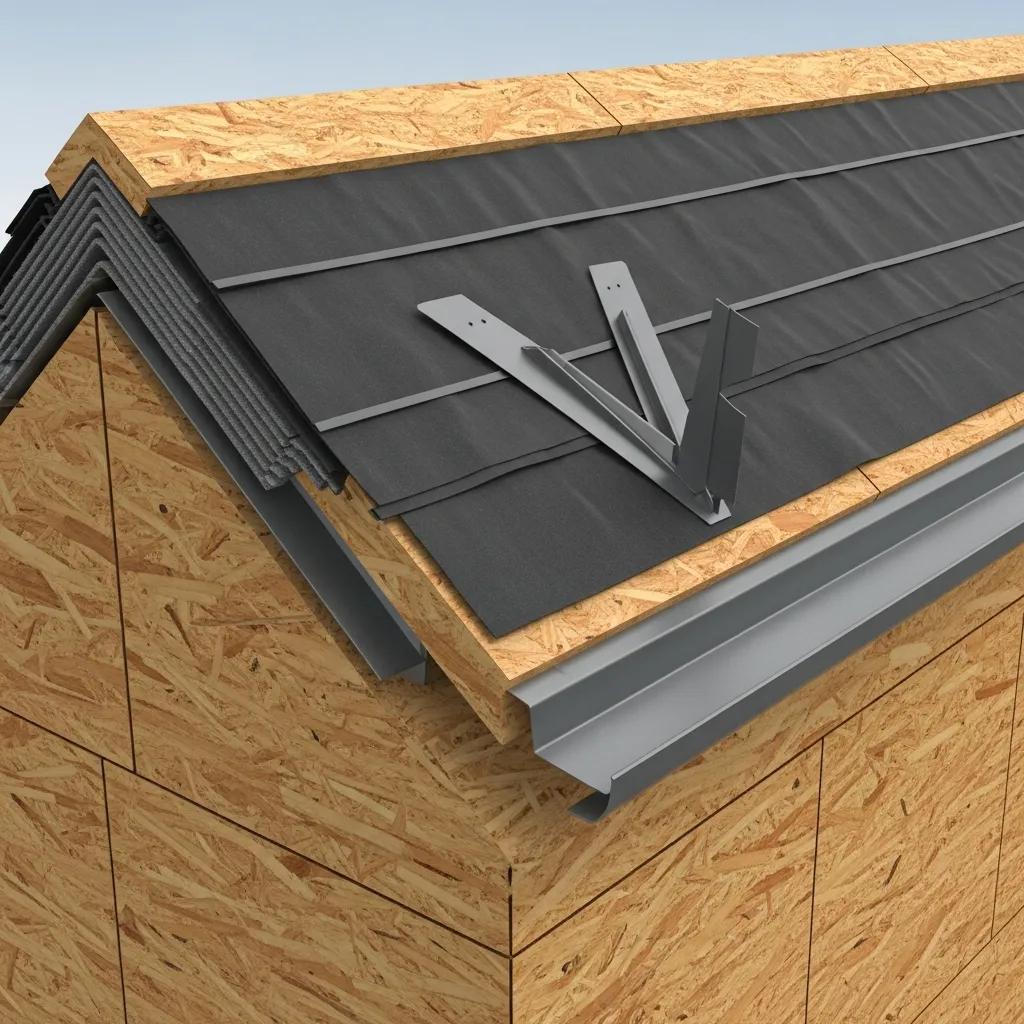
Ice and water shield is a self-adhering rubberized asphalt membrane that installs directly on roof decking, beneath the rest of the underlayment and shingles. Three characteristics make it the defining product for Minnesota roofs:
- Self-sealing around fasteners. When shingle nails penetrate ice-and-water shield, the rubberized asphalt seals around the nail shaft, creating a watertight seal. Regular felt or synthetic underlayment doesn’t do this — water can seep through nail holes.
- Adhered directly to decking. The product self-adheres to wood decking without mechanical fasteners, creating a continuous, peel-and-stick waterproof layer. No seams for water to find.
- Freeze-thaw and UV-stable. Engineered specifically for cold-climate performance. Handles Minnesota’s -20°F winter low and 95°F summer attic high without cracking, delaminating, or losing adhesion.
Popular brands available in Minneapolis in 2026: GAF WeatherWatch, GAF StormGuard, CertainTeed WinterGuard, Owens Corning WeatherLock, Grace Ice & Water Shield (GCP Applied Technologies), IKO ArmourGard. All perform similarly; your contractor’s choice often matches their primary shingle brand for warranty compatibility. For shingle brand context, see best asphalt shingle brands in Minneapolis. For the underlayment layer that sits above it, roofing underlayment types and Minnesota code.
Where Minnesota code requires ice and water shield
Minnesota Building Code follows IRC (International Residential Code) Section R905.1.2 for ice barrier requirements. Specific application zones required in 2026 Minneapolis construction:
- Eaves. Ice barrier required from the eave edge to a point at least 24” inside the exterior wall of the building. On typical Minneapolis homes with 12” overhangs, this means ice-and-water shield extends 36” total from the gutter line up the slope.
- Valleys. Full-length ice-and-water shield required in all roof valleys, typically 18” wide to either side of the valley centerline (36” total coverage).
- Around roof penetrations. Chimneys, skylights, vent stacks, and other penetrations should have ice-and-water shield installed around the perimeter for redundant waterproofing.
- Low-slope sections (2:12 to 4:12 pitch). Full-coverage ice-and-water shield recommended by most manufacturer specifications, not just at eaves.
- Transitions between roof sections. Where a lower-pitch roof meets a higher-pitch roof, ice-and-water shield should bridge the transition for at least 24” on each side.
Code is the minimum. Premium installs routinely exceed code requirements on ice-and-water shield coverage, particularly on homes with ice dam history or complex roof geometry. For the decking beneath, see roof decking: OSB vs plywood in Minneapolis.
When to extend ice and water shield beyond code minimum in Minneapolis
Five scenarios where Minneapolis homeowners should specify more ice-and-water shield coverage than Minnesota code requires:
- Prior ice dam damage. If you’ve had an ice dam back up water into your home within the last 10 years, extend ice-and-water shield to at least 6 feet from the eave edge. The code-minimum 3-foot coverage may not fully protect against repeat events.
- North-facing slopes with mature tree shade. North-facing roofs in tree-shaded Minneapolis neighborhoods hold snow and ice longer than south-facing slopes. Extended ice-and-water shield coverage (6–9 feet) on these slopes is smart.
- Complex roof geometry. Dormers, roof-to-wall intersections, cricket areas, and multi-plane roof designs create additional ice-accumulation zones. Full-coverage ice-and-water shield (8–12 feet from eave) on these homes prevents the edge-case failures that code-minimum installations still allow.
- Older homes with marginal attic ventilation or insulation. Poor attic performance drives ice dam formation. If your home’s attic isn’t up to current standards, extra ice-and-water shield coverage compensates. See attic ventilation and Minneapolis roof performance.
- Premium long-hold homes. If you plan to be in the home 15+ years, the incremental cost of extended coverage ($500–$2,000) is tiny compared to the cost of repairing ice-dam interior damage ($8,000–$30,000 or more). The insurance premium on a full-coverage install is genuinely good value on a long-hold property.
On homes with multiple risk factors, some Minneapolis contractors now specify full-roof ice-and-water shield coverage — every square foot of decking covered with rubberized membrane before underlayment and shingles go on. Total added cost: typically $2,500–$6,500 on a 25-square roof. For storm claim context, see the Minneapolis storm damage claim pillar.
The cost math on ice-and-water shield in Minneapolis is lopsided in a way most homeowners don’t calculate. A typical ice dam interior repair claim — drywall, insulation, floor refinish, paint — runs $8,000 to $30,000. Extending ice-and-water shield from 3-foot code minimum to 6-foot coverage costs $500 to $1,500. One avoided claim pays for the upgrade across the entire neighborhood. It’s the single highest-leverage specification decision on most Minnesota roof installs.
— Paraphrased from a 2024 Insurance Institute for Business & Home Safety briefing on cold-climate roof performance
How to verify ice and water shield on your Minneapolis roof install
Five checklist items to confirm ice-and-water shield is properly specified and installed:
- Product brand specified in contract. The contract should name the specific product (GAF WeatherWatch, CertainTeed WinterGuard, etc.) — not just “ice and water shield.” Generic language opens the door to cheaper substitutions.
- Linear feet of coverage quantified. Contract should specify feet of coverage at eaves, in valleys, and around penetrations. If your eaves need 280 linear feet of coverage at 3-foot width, that’s a specific quantity that can be verified on the final invoice.
- Installation pattern photographed. Quality contractors document ice-and-water shield installation with photos before underlayment covers it. Ask for photos — this is the single most useful piece of install documentation for long-term dispute resolution.
- Adhesion conditions met. Ice-and-water shield requires 40°F+ temperature to achieve full adhesion. In Minneapolis shoulder-season installs (late March, early November), this becomes a scheduling concern. Some premium products (GAF StormGuard) have lower-temp formulations for cold-weather install.
- Compatibility with selected shingle warranty. If you’re buying a premium manufacturer warranty (GAF Golden Pledge, CertainTeed 4-Star, Owens Corning Platinum), confirm the ice-and-water shield product matches the manufacturer’s approved list. Brand mismatches can void enhanced warranty coverage.
For the broader material selection, see the Minneapolis roofing materials pillar. For cost implications, the Minneapolis roof replacement cost pillar. For contractor selection, the Minneapolis roofing companies pillar. For flashing integration at penetrations, roof flashing, drip edge, and ridge caps. Further reading: the IBHS FORTIFIED cold-climate roofing resources, the NRCA consumer center, and the International Code Council IRC reference.
Frequently Asked Questions
How much ice and water shield does Minnesota code require?
Minnesota Building Code (following IRC R905.1.2) requires ice barrier at eaves extending at least 24” inside the exterior wall line — which means roughly 3 feet from the eave edge on typical Minneapolis homes. Valleys and penetrations should also have coverage. Full-coverage is not code-required but is increasingly specified on premium installs.
Is it worth paying for extra ice and water shield in Minneapolis?
Almost always, yes. The incremental cost of extending coverage from 3-foot code minimum to 6-foot best-practice is typically $500–$1,500. One avoided ice dam interior claim ($8,000–$30,000 or more in drywall, insulation, flooring damage) pays for the upgrade many times over. On long-hold homes, extra coverage is high-value.
What’s the difference between ice and water shield and regular underlayment?
Ice-and-water shield is a self-adhering rubberized asphalt membrane that seals around nail penetrations and adheres directly to decking without fasteners. Regular underlayment (felt or synthetic) is fastened mechanically and doesn’t self-seal. Ice-and-water shield is the only product that stops ice-dam back-up; regular underlayment can’t.
How long does ice and water shield last in Minneapolis?
Typically matches or exceeds shingle life — 25–40 years depending on product. The rubberized asphalt remains adhered and self-sealing for the life of the roof when installed properly. Premium products (GAF StormGuard, Grace Ice & Water Shield) are rated for the longest service life.
Where should ice and water shield be installed on a Minneapolis roof?
Code-minimum: eaves (3 feet from edge), all valleys, around penetrations. Best-practice: extend eaves coverage to 6 feet on homes with ice dam history, use full-coverage on low-slope sections under 4:12 pitch, and consider full-roof coverage on complex geometry or premium long-hold homes.
Looking for a Minneapolis roofer who exceeds code on ice and water shield coverage?
We’re Minneapolis Roofing Company — a licensed, insured, local crew that installs asphalt, metal, and synthetic systems across the Minneapolis metro. If you’re looking for a Minneapolis roofer who exceeds code on ice and water shield coverage, we’d love to be the name you recommend to your neighbor after the install.
