
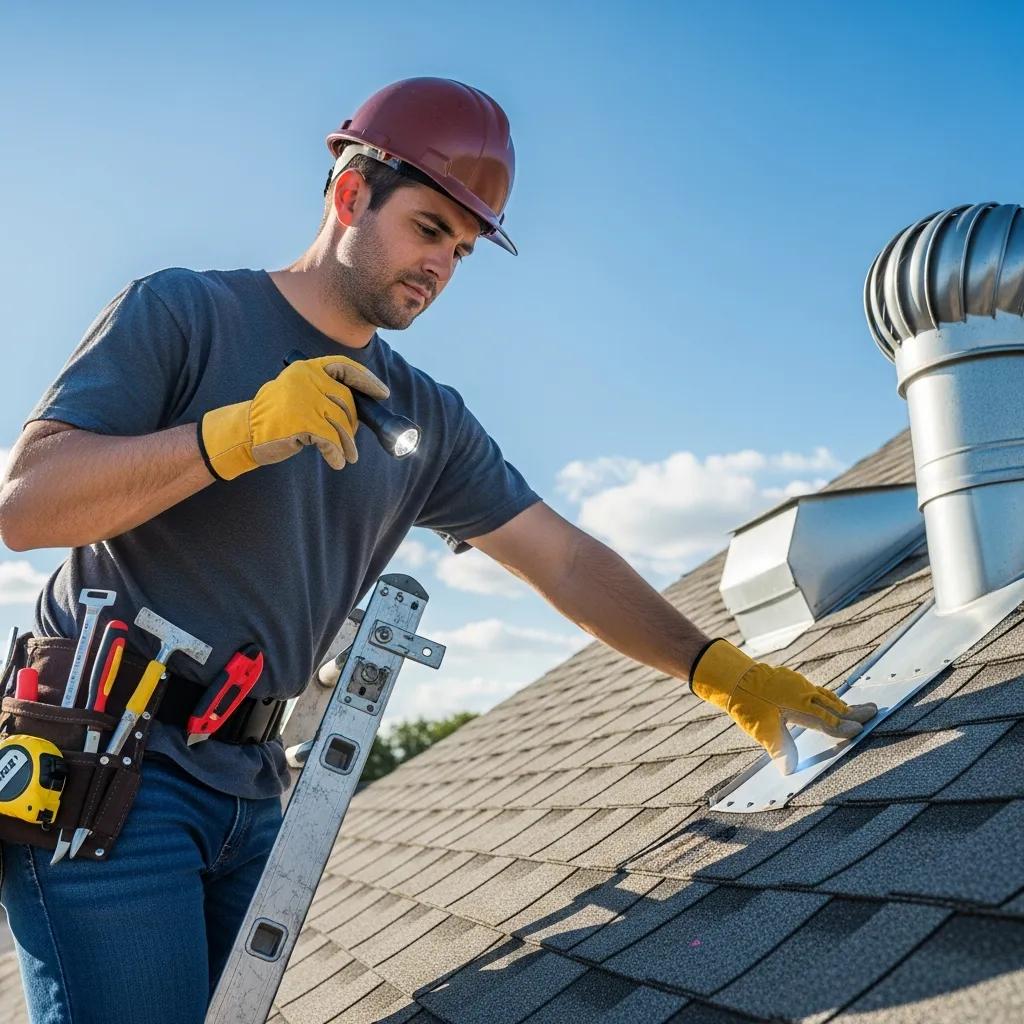
Roof Flashing Repair in Minneapolis: The #1 Hidden Leak Source (and How to Fix It Right)
Ask any experienced Minneapolis roofer where most leaks come from, and the answer will surprise most homeowners: it’s almost never the field of the shingles. It’s the flashing — the metal transitions where the roof meets chimneys, walls, skylights, valleys, and vents. Flashing is the most failure-prone part of a roof system, and it’s also the part most often done wrong during the original install or botched during re-roofing.
This is the practical guide to roof flashing repair in Minneapolis: why flashing is the #1 hidden leak source, how to tell step flashing from counter flashing from apron flashing (and why it matters), what proper flashing repair looks like, and what Minneapolis homeowners should expect to pay in 2026.
Why flashing is the #1 cause of Minneapolis roof leaks
A field of shingles has one job: shed water down the slope. Flashing has three jobs at once: shed water, seal a transition between two different materials, and handle differential movement as those materials expand and contract at different rates. That’s why flashing fails more often. Specifically in Minneapolis:
- Temperature swings stress flashing more than field shingles. Minnesota sees 120°F swings between January and July. Metal expands and contracts on a different schedule than asphalt, brick, or stucco. Over 15–20 years, that differential movement opens gaps at the flashing seams.
- Ice damming pushes water backward under the flashing. Normal flashing design assumes water runs downhill. Ice dams force water uphill under shingles and into flashing seams that weren’t designed to hold back standing water.
- Tar and caulk-dependent flashing fails fast. Many older Minneapolis homes (and plenty of newer ones, done by subpar crews) rely on tar or caulk to seal flashing instead of proper step or counter flashing overlap. Caulk is a 2–5 year solution used as a 25-year solution.
- Re-roofs often reuse old flashing. A lot of Minneapolis re-roofs in the 2010s reused original chimney flashing to save a few hours of labor. Ten years later, those reused flashings are the leak source on an otherwise sound new roof. See roof repair vs replacement in Minneapolis.
If you have a persistent leak that shows up in the same spot during heavy rain, there’s about an 80% chance the source is flashing failure — not the shingles around it. For the broader leak diagnosis, see roof leak repair in Minneapolis. For the full repair landscape, see the roof repair in Minneapolis pillar.
The six types of roof flashing on a Minneapolis home (and what they do)
Understanding flashing types matters because different failures need different repairs. Here’s the anatomy:
| Flashing type | Where it is | What fails | Typical repair cost 2026 |
|---|---|---|---|
| Step flashing | Where roof meets vertical walls | Seam separation, corrosion, caulk-dependent installs | $400–$1,500 |
| Counter flashing | Into a masonry wall (over step flashing) | Mortar joint failure, rust-through | $500–$1,800 |
| Apron flashing (headwall) | Where roof butts up to a wall at the top | Too short, poor integration, seam failure | $400–$1,200 |
| Chimney flashing | Around the chimney base | See chimney leak repair guide — complex system | $600–$2,500 |
| Drip edge | Rake and eave edges | Missing entirely on older homes, rust, lifting | $350–$1,200 per section |
| Valley flashing (open valley) | In roof valleys (when open-valley style) | Corrosion, pinholes, debris damming | $600–$2,000 |
The point for homeowners: when a contractor diagnoses a leak as “flashing failure,” the next question should be which flashing. A step flashing repair is different from a counter flashing repair. If the contractor can’t answer specifically, they haven’t actually diagnosed the problem. For chimney-specific flashing issues, see chimney leak repair in Minneapolis. For valley-specific issues, roof valley repair in Minneapolis. For the materials side, the Minneapolis roofing materials pillar.
What proper Minneapolis flashing repair looks like
The difference between a 3-year caulk-and-pray repair and a 25-year proper repair is visible on the roof if you know what to look for. Proper flashing repair involves:
- Removing the failed flashing entirely. Not caulking over it. Not adding a second piece of flashing on top. Pulling the damaged flashing out and installing new material properly integrated with the shingle courses.
- Individual step flashing pieces, not continuous strip. Every experienced Minneapolis roofer uses individual step flashings (one per shingle course) at roof-to-wall transitions. Continuous L-flashing or “shingle-and-caulk” solutions are the mark of cost-cutting that fails in 5–10 years.
- Proper counter flashing cut into masonry. On brick chimneys, the counter flashing should be cut into a reglet (groove) in the mortar joint and sealed with polyurethane sealant — not face-caulked to the brick surface. Cut-and-reglet flashing is how pros do it; face-caulked is how amateurs do it.
- Matching metal to exposure. Galvanized steel on most Minneapolis residential; aluminum if it matches siding; copper for premium applications (will last 40+ years but cost 3–5x more). Not plastic. Not thin tin that rusts through in 8 years.
- Proper overlap and orientation. Water runs down. Every flashing seam should lap over the piece below it, with 2”+ overlap. This is basic roofing physics that still gets done wrong routinely.
- Sealant only at final transitions. Polyurethane sealant, not silicone, not roofing tar, and only at the transitions where flashing terminates into dissimilar materials — not as the primary waterproofing.
If a Minneapolis contractor tells you they’re going to “seal up the flashing with some roof tar” or “put a bead of caulk on those seams,” that’s the sound of a 2-year patch. Walk away. For contractor vetting, see the Minneapolis roofing companies pillar. For the cost context, roof repair cost in Minneapolis. For replacement economics when flashing failure is widespread, the Minneapolis roof replacement cost pillar.
Flashing is craftsmanship, not product. You can buy the most expensive flashing metal available and still have it leak in 3 years if the installer doesn’t understand water management. You can buy standard galvanized steel and have it still be watertight in 30 years if the install was right. Pay for the craftsmanship.
— Paraphrased from NRCA technical guidance on flashing installation
When Minneapolis flashing repair turns into a bigger project
Sometimes a flashing repair is just a flashing repair: pull the bad section, install new, done in a day. Other times, the flashing problem is a symptom of something bigger. Signs that your flashing call is about to become a larger scope:
- Multiple flashing failures on the same roof. If step flashing at one wall failed, and apron flashing at another wall is also leaking, and the chimney flashing is questionable, the pattern points to original-install quality issues across the whole roof. Addressing them piecemeal costs more than addressing them together.
- Interior damage that extends beyond the leak point. If you’re seeing sheetrock staining, attic insulation saturation, or sheathing rot, the leak has been running longer than you thought. The flashing repair may be the cheapest part of the project.
- Roof is already 18+ years old. Spending $1,500 on flashing repairs on a roof with 2–3 years of life left is questionable economics. See roof repair vs replacement in Minneapolis.
- Flashing failure on a roof that was re-roofed in the last 5 years. That’s a workmanship issue, and it should be addressed by the contractor who did the re-roof — not patched by someone else. Check your original workmanship warranty.
- Insurance-qualified damage. If a storm event caused the flashing failure, the insurance claim may cover broader scope than just the flashing. See the Minneapolis storm damage claim pillar.
The honest read: roughly 15–20% of Minneapolis flashing-repair calls that start as small repairs grow into larger scope once a contractor actually gets on the roof and looks. That’s not a scam — that’s the difference between a ground-level guess and a roof-level diagnosis. Further reading: NRCA consumer center, IBHS FORTIFIED, and Minnesota DLI contractor licensing.
Frequently Asked Questions
How do I know if my Minneapolis roof leak is a flashing issue?
Flashing leaks typically show up in specific patterns: water stains near chimneys, skylights, walls, or valleys (not in the middle of open shingle field); leaks that appear during heavy rain or wind-driven rain but not light rain; and leaks that appear shortly after a winter ice dam event. Roughly 80% of Minneapolis leaks trace to flashing failure somewhere on the roof.
How much does flashing repair cost in Minneapolis?
Typical 2026 costs: step flashing repair $400–$1,500; counter flashing repair $500–$1,800; apron/headwall flashing $400–$1,200; chimney flashing $600–$2,500; drip edge section $350–$1,200; valley flashing $600–$2,000. Pricing depends on roof access, material choice, and whether interior damage also needs repair.
What’s the difference between step flashing and counter flashing?
Step flashing is individual L-shaped metal pieces installed at each shingle course where the roof meets a vertical wall. Counter flashing is a second layer installed over the step flashing (or into masonry) that seals the top edge. Brick chimneys use both: step flashing tied into the shingles, counter flashing cut into the mortar joint. You need both working together.
Can I caulk my roof flashing to stop a leak?
Short-term yes, long-term no. A bead of polyurethane sealant on a flashing seam may stop a leak for 1–3 years, but it’s a patch, not a repair. Proper flashing repair means removing the failed flashing and installing new material with correct overlap and integration. Caulk-dependent flashing fails predictably; we see it constantly on Minneapolis homes.
Should I replace all my flashing when I re-roof?
Yes, almost always. Reusing old flashing on a new roof is a classic Minneapolis shortcut that creates leaks within 5–10 years. The labor to replace flashing during a re-roof is modest; the cost to address leaks later on a brand-new roof is much higher. Insist on new step, counter, apron, chimney, and valley flashing as part of any full roof replacement.
Looking for a Minneapolis roofer for flashing repair and leak diagnosis?
We’re Minneapolis Roofing Company — a licensed, insured, local crew that handles everything from small leak repairs to full tear-offs across the Minneapolis metro. If you’re looking for a Minneapolis roofer for flashing repair and leak diagnosis, we’d love to be the name you recommend to your neighbor after the work is done.
